Wilkinson Reservation
Features:
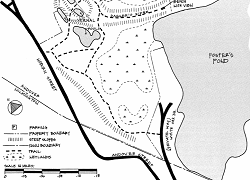
The glaciers that covered Andover 10,000-12,000 years ago shaped the topography of Wilkinson Reservation. There are numerous small kettlehole ponds here. These were created as the glaciers receded, when blocks of ice were left behind in the outwash plains. These ice blocks melted, forming depressions. If these depressions were below the water table, they filled with water, becoming kettlehole ponds.
Narrow trails through white oaks and tall white and red pines wind along eskers, up and down from one kettlehole pond to another. Eskers are ridges of rocks and coarse gravel that were deposited by meltwater streams flowing through crevices and tunnels in the glacier. They can be as high as 100 feet and several miles long. Wilkinson Reservation contains several lower but steeply banked eskers.
A ridge overlooking the marshy end of Foster’s Pond offers bird watching opportunities. A sturdy bench built by an Eagle Scout provides a comfortable resting spot. A mating pair of blue herons have been observed here and an osprey has been sighted in an impressive grove of graceful hemlocks.
In spring, Wilkinson woodlands are filled with lady slippers, trilliums, white swamp azaleas, pinks, mountain laurel and many more wildflowers and flowering shrubs. The kettlehole ponds are home to several species of frogs and other amphibians.
Though not large, this reservation is rich in geological interests, wildflowers, and lovely trees.
History:
Wilkinson Reservation was given to AVIS in 1981 by Irvin and Marsha Wilkinson, to be preserved and cared for. Their son, David, a science teacher at Andover High School, used this geologically interesting property as a laboratory for his students.
Deer Hunting:
Deer hunting with bow and arrow from tree stands will be allowed on this Reservation during the state bow hunting season. For more information, see here.
Size:
23 acres
Location:
On Woburn Street, South of Rattlesnake Hill Road
Web Map:
Open HereParking:
Along Woburn Street on the same side of the street as the reservation, just South of Rattlesnake Hill Road. Please do not park on the private land across from the entrance on Woburn Street.
Wardens:
John Lugus
 Andover Mass Trails & River Web Map